Showing posts with label dialogue. Show all posts

Monday, June 13, 2016

Showing Emotion

43d4ee99fe68c3bc73740d5e3f73bdbf
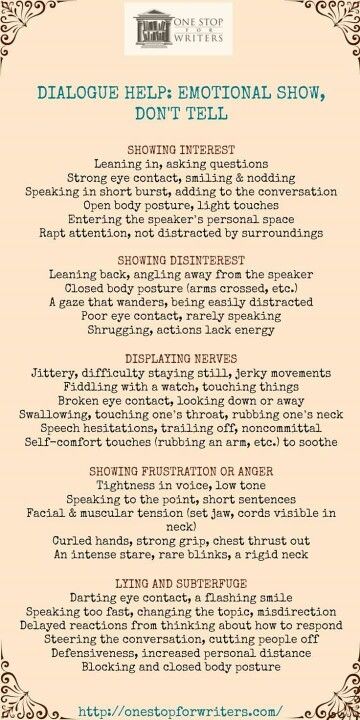
I find so many helpful writing tips on Pinterest, and showing emotion through dialogue hasn't come as naturally to me as I thought it would as far as what the character is doing while either speaking or listening to whoever is in the scene with them. However, this post from The Writer's Handbook Tumblr blog,  who shared it from  One Stop For Writer's Pinterest board explains the way to show important emotions that for some reason haven't come easy to me.
Emotions such showing interest or disinterest in a character, showing nervousness, frustration or anger, (such as trembling or clenching their fists), sadness, etc. While I'm reading a good book for the first time, the plot itself holds my attention, which is exactly what our books should do for readers. When the writing is so well done that I barely pay attention to the grammar and writing style of the author the first time I read it, that is a story that I will read again from my writer's mind.

Monday, September 5, 2011

Write Great Dialogue: Part Two


I was out of town this Friday and did not have the chance to post this on Friday. My father-in-law passed away and I traveled to Pittsburgh, PA for his funeral.

Last Monday I wrote the first half of how to write great dialogue. Today we'll talk about the importance of conflict or tension in fiction, something I'm still learning how to do.

Great dialogue leaves the dull parts of conversation out, so that the protagonist is dealing with the change, threat, or challenges. Imagine reading this conversation:

 "How is that new toaster working for you?" Babs asked.
"Oh, it's marvelous," Mary said. "I'm really glad I got this one. It's at Target, on sale."
"Really? I may just have to get one for myself."
"Do. You'll love it. You'll absolutely love it."
Babs took a sip of her coffee. "Mm, this is good. What blend?"
"French Roast."
"I adore French Roast."
"Me too."

In reading this, you would think neither one has a care in the world, and wouldn't believe that Mary's husband is in the hospital.

This conversation seems more realistic:

"How is that new toaster working for you?" Babs asked.
"Hm?"
"The toaster. How's it working?"
"It toasts."
"Yes?"
"Yes. It toasts."
"I didn't mean to-"
"What do you think it does?"
Babs took a sip of her coffee. They sat in silence for a long moment.

This shows a distracted Mary not paying attention when Babs asks about a toaster. Their conversation takes an awkward turn which leaves them in silence.

Writing dialogue like this is taking me a long time to learn. What are your tips for writing dialogue?

*This post was taken from the book, "Revision & Self-Editing" by James Scott Bell.

Monday, August 29, 2011

Write Great Dialogue: Part One

 I've been studying my writing books as I edit The Enchanted Locket and wanted to share some essentials to writing great dialogue from the book, Revision & Self-Editing by James Scott Bell.

Dialogue is another form of character action in fictional stories. It must be essential to the story with three goals in mind: advance the plot, reveal the characters, and reflect the theme of your story.

To advance the plot, dialogue reveals important information for the story, such as background, exposition, or help us understand what's happening in a scene. An example of this is:

"Bill," Sheila said. "What are you doing here? I thought you were going to be in Baltimore."
"We have some unfinished business, sweetheart."

We know from this exchange that as far as Sheila was concerned, Bill was supposed to be in Baltimore, and he has something on his mind that he wants to discuss that may be terrible for her.

Dialogue reveals both character and character relationships by the way people talk. One character may talk in casual and short, clipped sentences, while another character speaks in a refined, formal manner.

Dialogue illuminates theme such as the simple life of the hobbits made them much less tempted to use the evil ring and man's desire for power in the epic tale, The Lord of the Rings trilogy. All of the nine men who took Sauron's rings desired power and were the easiest to to seduce and corrupt to the evil of the ring.

It comes from one character to another character
gives a good example of what not to write:
Ted stood there.
 "Oh hello, Ted, our family doctor from Baltimore," Mary said. "Please come in."
 Ted walked through the door.
 "Mary," Ted said, "I'm so glad you were home here on Mockingbird Lane."
 "I am too, Ted. I am comforted that you're here. Having a doctor who is six feet, four inches and in good shape, but even better knows what he's talking about, is a wonderful thing for a forty-year-old woman in crisis to have visit her."
 The author is attempting to slip information to the readers by hitting them over the head with it. It's so bad you can't help but snicker at it. While dialogue is an excellent way to impart information, it must be written from one the view point of one character to another. (We'll come back to this in Friday's post).

Friday's post will discuss conflict and other essentials to writing believable dialogue. Which books have you been moved with dialogue? Do you have any favorites you wish to share?